I was 27 when I got diagnosed with Graves’ Disease.
My energy was gone. My sleep was wrecked. My hormones were a mess. I’d been grinding for years, and my body finally sent the bill. The conventional answer was radioactive iodine to kill my thyroid, followed by synthetic hormones for the rest of my life. I wasn’t ready to accept that at 27.
So I did something that looked crazy from the outside. I quit my job, moved to the desert, ate real food, and got back to the basics. I took my nervous system off the gas pedal and kept it there, which turned out to be the hard part. One year later my diagnosis went into remission.
That experience changed everything about how I practice. Because here’s what I figured out the hard way — the body isn’t broken when it’s sick. It’s responding exactly the way it’s designed to respond to the environment it’s living in. Change the environment, and the body remembers what to do.
This is Dr. Matt, by the way. And this page is about the approach that got me my health back, the same approach we’ve used with thousands of patients at our South Austin clinic. We call it holistic health, but that word has been watered down so badly it barely means anything anymore. So let me tell you what we actually mean by it.
Most of what gets sold as holistic health right now isn’t holistic at all. It’s just symptom management with better branding.
Your neck hurts? Here’s a pill. Your energy’s low? Must be age. Your digestion’s off? Try this supplement and come back in six months. That’s not holistic. That’s the same old specialist model wearing a wellness T-shirt.
Real holistic health means looking at the body the way a fifth grader learns it in biology class — as a system of systems. Immune, digestive, muscular, hormonal, all working together, all controlled by one thing. The nervous system is the master control center. When it’s balanced, everything downstream works better. When it’s stuck in stress mode for too long, everything downstream starts falling apart.
This is why the back pain, the anxiety, the hormone imbalances, and the gut issues all tend to show up together. Different labels, same root cause. Most people have been taught to see each of those as its own problem requiring its own specialist. We see it differently.
One overloaded nervous system. One foundation to rebuild.

Here’s what most healthcare gets wrong about the body. It treats you like a car.
Something breaks, find the broken part, replace it. Move on. That model works for machines, but it doesn’t work for us. We’re not assembled in a factory. We’re more like plants. Living systems that respond to the environment we’re planted in.
A wilted plant doesn’t need surgery on its leaves. It needs better soil, more light, the right amount of water. Change the environment and the plant comes back on its own, because that’s what living systems are designed to do.
Your body works the same way. And the environment your nervous system is actually responding to isn’t genetics or age or bad luck. It’s lifestyle. We see it every day — people overscheduled, underslept, carrying old injuries they never fully recovered from, living under more pressure than their system was built to handle.
We call the four biggest lifestyle factors the Core 4: sleep, stress, movement, and toxins. These are the levers that actually move the needle on how your nervous system functions. Supplements and protocols are pennies. The Core 4 is the dollars.
Everything else we’ll talk about on this page comes back to these four.

A few years ago, a woman came into our office with Parkinson’s. She needed help walking. She couldn’t drive. Sitting, standing, changing positions — every one of those required assistance from someone else. By the time she found us, she’d been told this was the trajectory. Manage it, slow it down if you can, but expect it to progress.
We worked together on the nervous system side. She took ownership of the rest. She started with two of the Core 4 first, movement and stress, because that’s where she had the most room to grow. Slowly, over months, she layered in the other two.
A few years later, she walked back into our office. No cane. No helper. Just her. She was moving freely, driving again, dancing at family events. I asked her what she’d done differently.
Her answer was almost too simple to believe. “I changed my lifestyle. I started moving more. I lowered my stress. I built a community.”
That was it. No miracle protocol. No expensive stack of supplements. She honored what her body was built to do when the foundation got rebuilt underneath it, and her body did the rest.
This is the part of healthcare that gets lost. The body has an incredible capacity to heal when the environment supports it. We’ve watched it happen with dysautonomia, chronic pain, autoimmune conditions, fatigue that no one could explain. Not every case looks like hers. But the pattern is consistent enough that we’ve stopped being surprised by what the body can do when you give it the right inputs.
Just like a plant comes back to life with sunlight and water, so do we.
If you’re reading this and thinking “okay, the Core 4 makes sense, but where do I even begin,” that’s the most common response we get.
The honest answer is that the four pillars aren’t equally broken for everyone. Some people are sleeping great but living in chronic stress. Some are managing stress well but have never moved their body the way it was designed to move. For most people, one or two pillars carry most of the weight, and starting there creates the biggest shift the fastest.
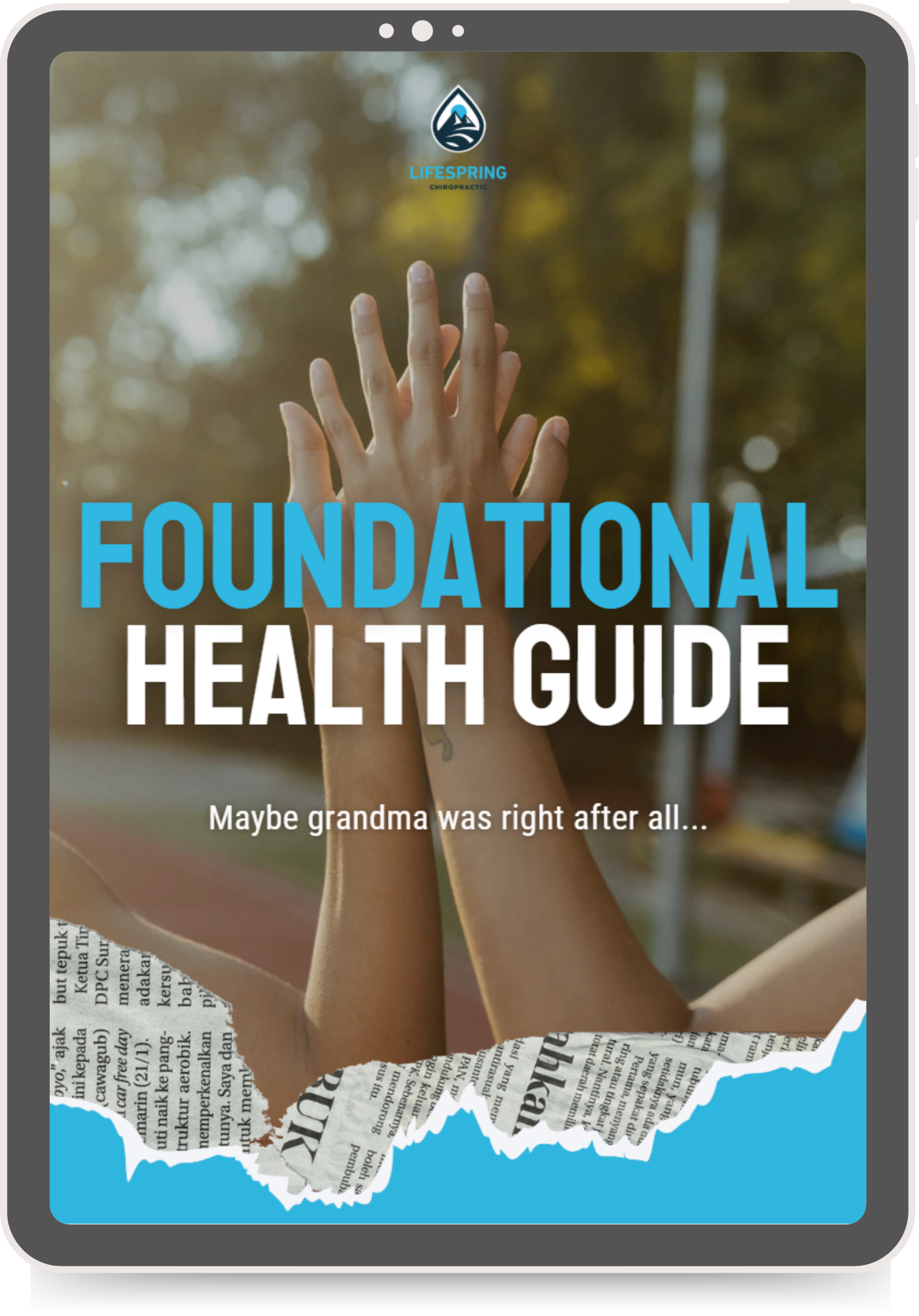
That’s why we built the Foundational Health Guide. It’s the same framework we walk our patients through when they first come in, turned into something you can work through on your own time.
Inside, you’ll find a deeper breakdown of each Core 4 pillar, the most common blind spots that stall healing, specific action steps you can start this week, and a progress checklist so you can track what’s actually moving.
Most people don’t need more information. They need a clearer place to start.
If someone comes into our office with chronic back pain, one of the first questions we ask isn’t about stretching or posture. It’s about sleep.
That throws a lot of people. They came in for their back. Why are we asking about their sleep?
Because sleep is when the nervous system actually resets. It’s when the brain clears metabolic waste, muscles repair, hormones recalibrate, and stress physiology gets a chance to come down. Shortchange that window and every other system in the body pays the price the next day. Sleep expert Dr. Matthew Walker said it best: sleep is the single most effective thing we can do to reset our brain and body health.
The problem is that most people are running on sleep debt they’ve stopped noticing. Two-thirds of adults don’t get enough. And the effects aren’t subtle once you know what to look for. Blood sugar regulation tanks. Hormones swing. Muscles stay guarded. Stress reactivity goes up. Healing slows down.
You can do everything else right — clean diet, consistent workouts, meditation app, the whole list — and if you’re sleeping five hours a night, the nervous system stays stuck in stress mode. No amount of effort downstream fixes that.
This is why sleep is where we start with most patients. Not because it’s the only thing that matters, but because nothing else lands until this one does.
Movement isn’t punishment for eating too much. It’s how your body and brain stay in conversation with each other.
Every time you move, your body sends information upstream to your brain. Joints report their position. Muscles report their tension. Balance sensors report where you are in space. The brain takes all of that, processes it, and sends signals back down that keep circulation flowing, lymph moving, and coordination sharp. Stop the movement, and you stop the conversation.
This is why we ask about movement patterns, not just workout frequency. Because here’s what we hear constantly: “I already get my movement in. I go to the gym every day.”
Then they sit for the next nine hours.
We call this the AQ problem — Ass Quotient. High AQ means high time spent sitting, regardless of how hard you crushed your morning workout. The body wasn’t designed to hold one position for eight hours and then go all-out for forty-five minutes to compensate. It was designed for consistent, varied motion throughout the day.
That’s the medicine the brain is actually asking for. Not intensity. Frequency, variety, and consistency. A short walk after lunch does more for your nervous system than you think. Changing positions every thirty minutes matters more than your split. How you move when you’re not “working out” is where most of the wins hide.
Toxins get framed as the scary stuff on the evening news — pesticides, heavy metals, mystery chemicals. Those matter, but they’re not what we see driving the most damage in our patients’ day-to-day lives.
What we see is blood sugar.
Most people are running through their day on a glucose rollercoaster without realizing it. Morning bagel, afternoon coffee with sugar, wine with dinner, dessert after. Each spike triggers an inflammatory response. Each inflammatory response puts the nervous system on alert. Do that three or four times a day for years, and the body is fighting a fire that never quite goes out.
This is why someone can be eating “healthy” by modern standards and still feel inflamed, foggy, and stuck. It’s not what you’re eating. It’s what your blood sugar is doing in response.
We’re not here to play food cop. We’re here to show you how to actually track what’s happening inside your own body. One of our favorite tools is a continuous glucose monitor, which is now available over the counter. Wear one for two weeks and you’ll learn more about your own chemistry than any bloodwork has ever told you. You’ll see which foods spike you hardest. You’ll see which combinations keep you stable. You’ll see the meal that looked “healthy” and the one that actually was.
Because if you keep feeding the fire, no amount of stretching is going to fix your back pain.
If your body feels like it’s being chased by a bear while you’re sitting at your desk, you’re not going to heal.
That’s not a metaphor we use for drama. That’s what we actually see on our scans, every day. Nervous systems stuck in a survival response that was designed to last ninety seconds — the length of an actual threat — now running for years on end.
Here’s what people miss about this response. It’s not always triggered by trauma or crisis. It’s traffic. Deadlines. A full calendar. Late nights answering emails. The sound of your phone buzzing every forty seconds. Your body doesn’t know the difference between a real bear and a Tuesday afternoon. It just reacts the same way either way.
And when that reaction runs long enough, the body stops prioritizing anything that isn’t survival. Healing takes a back seat. Digestion slows. Hormones get chaotic. Muscles stay guarded. Anxiety climbs. This isn’t your body failing you. It’s your body doing exactly what it was designed to do, in an environment it wasn’t designed for.
This is where we use nervous system testing with our INSiGHT nervous system scans to measure how adaptable your nervous system actually is. In plain language, how stuck are you in stress mode, and how much reserve do you have left to come out of it? Most people have never had this measured, and it tends to explain a lot.
Because until the nervous system gets out of survival, nothing else downstream has a chance to work.

Most first visits in healthcare follow the same script. Where does it hurt? How long has it been going on? Let’s take a quick look and get you adjusted.
Ours doesn’t work that way.
Before we recommend anything, we play detective. We ask about the stress seasons you pushed through but never fully recovered from. The old injuries you walked away from feeling fine. The sleep that’s been off for years even when everything else looked okay. The Core 4, essentially, but looking backward through your life instead of forward. That history matters more than most providers realize, and we take time with it.
Then we scan. You saw one version of these scans earlier in the stress section — what that actually looks like in practice is three non-invasive INSiGHT nervous system scans measuring heart rate variability, surface muscle tension along the spine, and thermal nerve mapping from the top of the spinal cord to the base. Together, they tell us where your nervous system is carrying the load and where we need to start.
From there, we build a care plan using our TriChord Method™. Three layers working together — nervous system-focused adjustments to restore communication, extremity support especially in the feet, and ligament stabilization to lock in what we’re building. This isn’t crack-and-pray chiropractic. It’s strategic, measurable, and built around what your scans actually show.
And we don’t stop with what happens in the office. Every care plan includes a home strategy built around the Core 4, because the hour you spend with us matters less than the other 167 hours of your week. That’s where real healing gets won or lost.

And we don’t stop there.
We layer in a custom home care plan built around the Core 4. Because there’s almost always something someone is doing (or not doing) that’s slowing progress down. Stretching and rehab exercises? They’re rarely the problem.
But the moment your brain becomes aware of something that’s been off? It can recalibrate.
It can fix almost anything. That’s what real healing looks like — and that’s what we do here.

Here’s what we’ve watched play out thousands of times. Someone spends years chasing one symptom at a time. They see the back specialist for the back. The gut doctor for the gut. The psychiatrist for the anxiety. Each provider treats their square inch, each one sounds reasonable, and nothing ever quite holds.
The problem isn’t that the specialists were wrong. The problem is that nobody ever asked whether all of it might be coming from the same place.
Your body isn’t a collection of separate parts that happen to be stored in the same skin. It’s one system, run by one nervous system, responding to one environment. When that environment is off, every downstream system reflects it. When the environment gets rebuilt, the systems come back online together. That’s not wishful thinking — it’s what we measure with patients every week.
You’ve probably been told to just live with it. Your pain, your fatigue, your hormones, your anxiety. That these are things to manage forever, not things that can actually shift.
We don’t accept that, and the data doesn’t either.
Your body isn’t broken. It’s brilliant. It’s been asking for a different environment, not a different diagnosis.
If you want to see what your nervous system has actually been carrying, one visit is all it takes. Three scans. A real conversation about what’s been building underneath your symptoms. A plan that finally connects the dots instead of separating them further.
And if you’ve already been through the specialists, the supplements, the diagnoses, and you’re tired of being told there’s nothing left to try — you can read more about how we approach this kind of complexity on our Austin holistic doctors page.
|
Office Hours
|
Monday
|
8am - 1pm | 2:30 - 6pm
|
|---|---|
|
Tuesday
|
8am - 1pm | 2:30 - 6pm
|
|
Wednesday
|
8am - 1pm | 2:30 - 6pm
|
|
Thursday
|
8am - 1pm | 2:30 - 6pm
|
|
Friday
|
8am - 1pm | 2:30 - 6pm
|
|
Saturday & Sunday
|
Closed
|

“I didn’t know anxiety could be helped through a chiropractor.”

“I joked with him — I thought it was some magic trick on me.”

“It was like my conductor was off… and now he gets to speak loud to my body.”

The Lifespring Chiropractic team—trained in the TriChord Method™ and dedicated to helping Austinites heal through nervous system-based care.
Lifespring Chiropractic was founded by Dr. Matt Delgado, DC, creator of the TriChord Method™. Our team of Austin chiropractors is trained in advanced nervous system-based care, using INSiGHT Scans to uncover the root causes of stress and dysfunction.
Learn more about our philosophy and approach on our Our Approach.
Most people think holistic health means supplements or green juice. At Lifespring, we define holistic health in Austin differently — it’s about understanding how every system in your body works together. We start with the nervous system — because when it’s balanced, everything else (digestion, sleep, hormones, energy) falls back into place.
A lot of people call themselves “holistic,” but most are really just offering a more natural way to manage symptoms. Our approach goes deeper. Through our testing, we look at the body’s most foundational system — the nervous system — to see how it’s actually functioning. From there, we use nervous system–focused chiropractic adjustments and home care built around our Core 4 pillars — Sleep, Stress, Movement, and Toxins. This combination helps restore real function to the body, not just mask the problem with “natural” band-aids.
Not at all. Many of our patients continue working with their medical doctors. Our Austin holistic health care approach isn’t about replacing — it’s about completing the picture. We fill in the missing piece: restoring balance to the nervous system so your body can respond better to everything else you’re already doing.
Because the nervous system connects everything, improvements often show up everywhere — better sleep, calmer digestion, steadier moods, sharper focus, less pain. Most people who come to us for holistic health in Austin notice that when we calm the nervous system, their body starts healing in ways they didn’t expect.
Lifestyle is part of it, but we go much deeper. We use INSiGHT scans to measure how your nervous system is actually functioning, then pair that data with simple, doable changes in the Core 4 areas. The result: measurable, lasting shifts in how you feel, not just good intentions.
Start by taking the free Nervous System Scorecard — it only takes two minutes and shows which Core 4 pillar may be holding you back. From there, we’ll build a personalized plan that supports your nervous system and helps you finally feel like yourself again. Ready to begin?
Book your Health Assessment today and see where real holistic health starts.
If you’ve already seen us in the recent months, enter your information below to look up available slots. Your information must match our records. If not, close this pop-up and request an appointment as a new patient.